
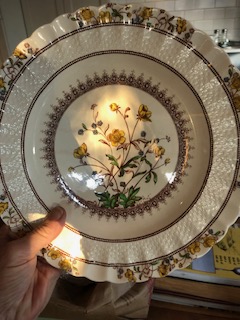
Buttercups are one of those weeds/wild flowers which are quite nostalgic because as children they are one of the first flowers to learn and to wonder at with their incredible yellow flower. As an adult the attitude changes as many regard them as pernicious weeds. Spode produced a pattern called Buttercup which became very popular, particularly in America.
In the Spode archive there is a record of a buttercup pattern which is a hand painted design recorded with pattern number 1/4265. This was produced on bone china in about 1885. It is thought to have been designed by Felix Xavier Abraham*, a fine artist, who worked at the factory between about 1882 and c1902. He was Art Director for a short time. Probably influenced by this hand painted design, Buttercup appeared in about 1896 in something akin to its most popular form, on earthenware, on Chelsea Wicker shape. It had pattern number 2/4187 and was printed in outline from a hand engraved copper plate and then hand coloured.
Also in 1896 a differently coloured version appeared with pattern number 2/4191 and called Mandalay. This was in reds and browns. However the best known version has pattern number 2/7873 and was first recorded in 1924 remaining in production until 1992. Many customers who wanted to add to their services asked for its reintroduction and this finally happened in 2000 but sadly was not the success it was expected to be.
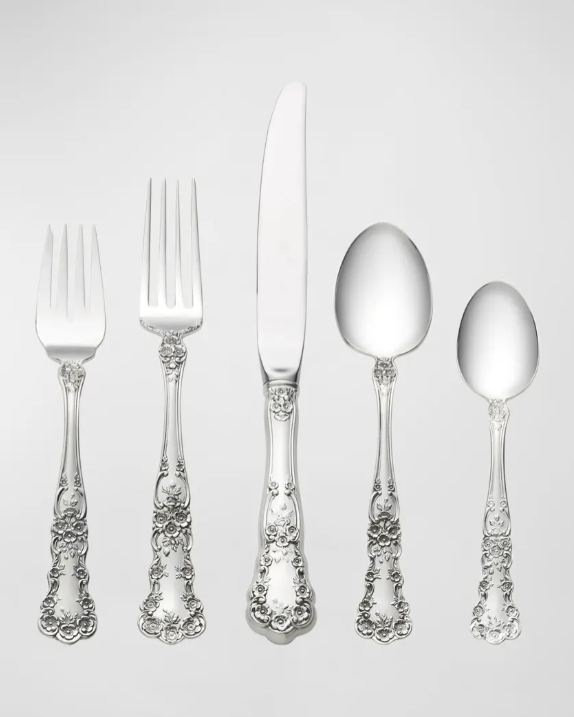
The Gorham Buttercup Sterling Silverware is a classic and timeless pattern that has been popular for over a century. First introduced in 1899, it continues to be a favorite among silverware collectors and homeowners alike. What sets the Gorham Buttercup apart from other patterns is its intricate and elegant design. The handles of each piece are adorned with delicate flowers, giving them a feminine and romantic touch. This attention to detail is what makes the Buttercup pattern stand out.
One important thing to note about this silverware set is that it has a matte/satin finish. This means that it has a soft, non-reflective surface, giving it a more subdued and sophisticated look compared to other shiny silverware patterns. Interestingly, Gorham applies a tarnish at the factory on each Buttercup piece. This tarnish actually helps highlight the intricate flower design on the handles, making them stand out even more. To maintain its unique finish, it is recommended to use a standard silver polish instead of a silver dip, which can be harsh and potentially damage the delicate design. It’s no wonder that the Buttercup pattern has stood the test of time and remains a beloved choice for formal dining occasions.
 Blue Settee